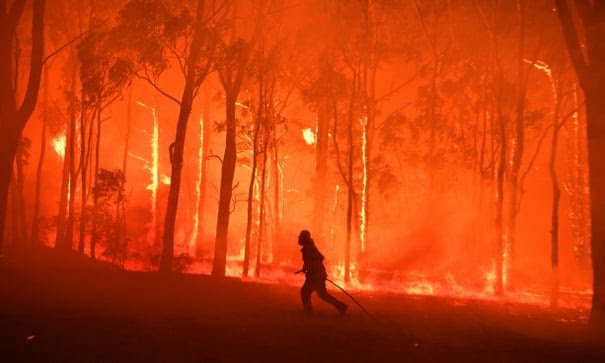
Australia’s atmosphere is famous for its instability, yet this current summer’s high temperatures — cresting at near 120 degrees Fahrenheit in December — and ensuing flames have still been anomalies.
The nation itself traverses a locale from the tropics in the north to increasingly calm atmospheres in the south, with deserts in the center. It likewise sits between two significant seas and is pounded by the moving dissemination examples of both. So the climate over the mainland can change radically year to year and become hard to foresee. In any case, Sarah Perkins-Kirkpatrick, a senior instructor at the Environmental Change Exploration Center at the College of New South Ridges, Sydney, clarified that there were notice signs that the current year’s late spring in Australia would get ruthlessly hot.
One sign was that the Indian Sea Dipole, the cycle of the temperature angle between the eastern and western pieces of the Indian Sea, was in its positive stage this year. That prompted considerably less precipitation over Australia as common breezes pushed dampness assembling over the Indian Sea away from the landmass in the spring.
Another alert this year was the Southern Annular Mode. This depicts the development of the round belt of wind around Antarctica as it moves north or south. It’s in its negative stage at the present time, carrying dry conditions to Australia. This year, it likewise mixed with a flood of warmth in the stratosphere, directing gobs of hot, dry air to southern Australia.
And keeping in mind that Australia’s yearly rainstorm rains in the northern piece of the nation snuck up suddenly in February, causing perilous flooding in the province of Queensland, they were likewise bogged down. That enabled more warmth to gather over the focal piece of the nation this year.
Simultaneously, there were longer-term factors at work. One of them is that a lot of Australia is confronting an extreme dry season, prodded by three winters in succession with next to no precipitation.
“That is never occurred in the instrumental record,” Michael Roderick, an atmosphere scientist at the Australian National College told the Sydney Morning Envoy in November. “They’ve never truly had two bombed winters in succession.”
With dry season conditions, there is less dampness dissipating in the warmth, a marvel that typically has a cooling impact.
At the same time, the atmosphere is getting more sizzling. “Australia’s atmosphere has warmed by simply over 1° C since 1910, prompting an expansion in the recurrence of outrageous warmth occasions,” as indicated by the Australian Agency of Meteorology’s 2018 Condition of the Atmosphere report. This has additionally prompted more precipitation in northern Australia, however less in the southeast, where most Australians live.
These meeting factors are the reason the temperatures in the nation have been so incredibly hot. Australia broke a warmth record on December 17, arriving at a national normal temperature of 105.6 degrees Fahrenheit. That record was broken the extremely following day, averaging 107.4.
“This in itself (the record being broken toward the beginning of the period, being broken two days straight, and by such an enormous edge) is remarkable,” Perkins-Kirkpatrick said. “On the off chance that the atmosphere wasn’t changing, the possibility of this occurrence is absurdly low.


www.theguardian.com
Web results
Australia bushfires factcheck: are this year’s fires unprecedented?
 Life Style in JLU
